We Renumbered The Whole Lab And The Paperwork Survived
Thirty-something devices, one spreadsheet, and the week my network stopped being an archaeological site.
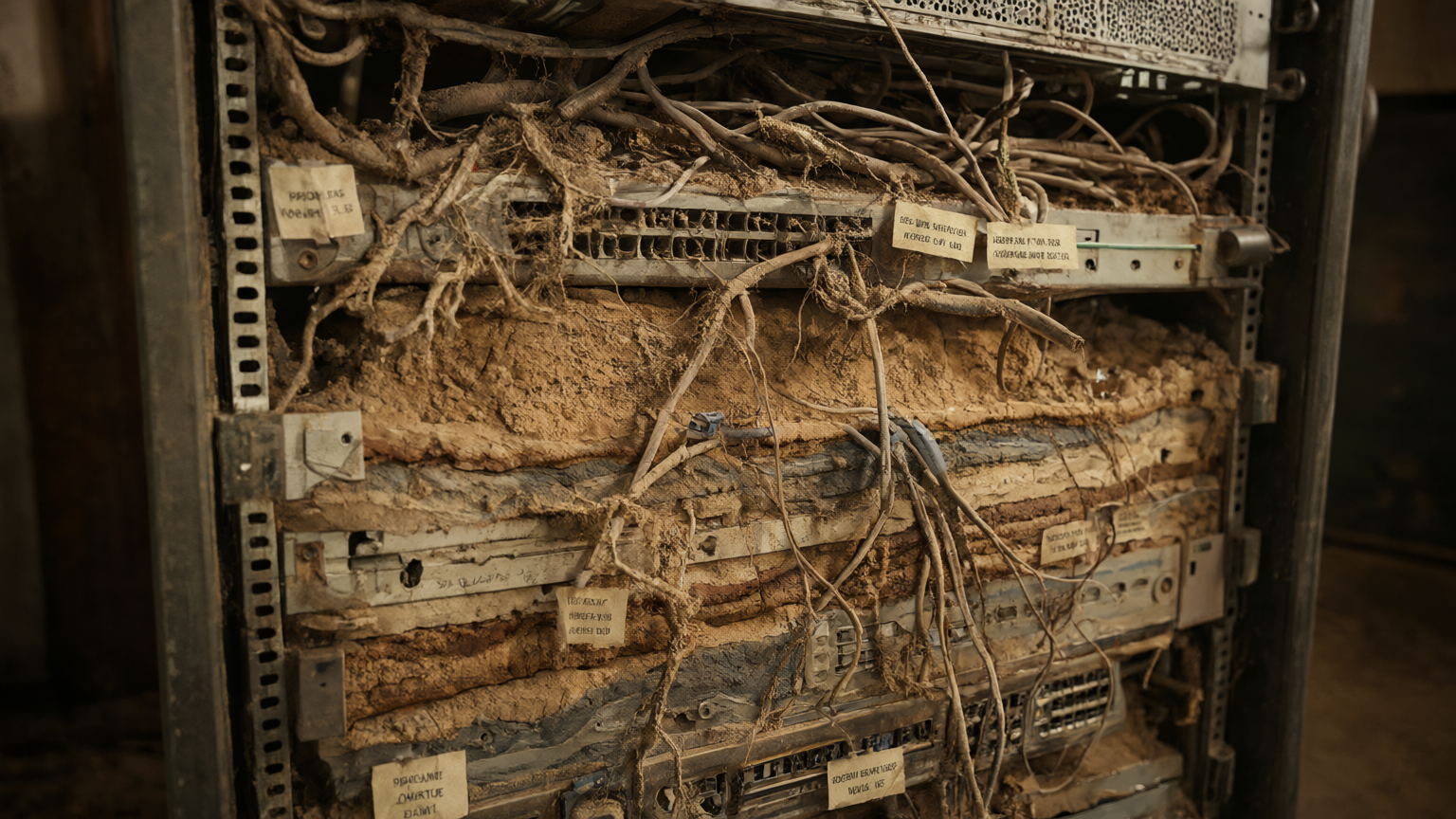
Comp-artist's impression of my rack during the survey phase. The dust layer is structural, allegedly.
Every homelab becomes an archaeological dig. Layer one: the sensible scheme from the setup guide, written by a past me who clearly had his life together. Layer two: "static lease, I promise it's temporary," dated fourteen months ago. Layer three: whatever got moved at eleven at night and never told the documentation. Somewhere near the bedrock is a device I am now formally not sure I own.
I stopped being able to find my own servers. Locating one required either a memory map committed to years ago, or an arp-scan and the optimism of a gold prospector. My network had no addressing scheme. It had strata, and I was running out of years in which to remember which one held the good stuff.
So: renumber the lot. Weekday, because a weekend renumber is just discovering you have no life on two consecutive days.
The treaty, signed at gunpoint by me
Rules first, in writing, because a renumber without written rules is a hostage situation with better lighting.
One flat network. VLANs in a home are a fantasy genre. The smart fridge and the gaming PC are not holding threat-model conversations, and the fridge is losing either way.
Nothing above the gateway changes. The gateway is the sun of this solar system. Planets relocate; the sun sits down and behaves. Anyone suggesting we "while we're in there" also change something upstream gets their wrists in cuffs.
Outage fine. Weird not. Everything may be down all afternoon; that's a Tuesday. Nothing may come back working but strange. "Strange" is the failure mode that ends marriages, and I say that as a man whose marriage survived this one with only minor radiation.
Neighbourhoods, because the map should explain itself
The real fix wasn't addresses, it was geography. Every purpose got a neighbourhood: edge gear together, virtualisation nodes together with a deliberately empty stretch reserved for the nodes future-me will inevitably buy, because future-me treats a "final" rack layout the way a toddler treats "one" biscuit. The GPU cluster, loud and space-heating, got its own block; "AI, storage, apps, and the toaster" is a grouping scheme, and the toaster is not flattered.
The payoff: addresses become deducible. A new box arrives and you know where it goes without opening a single note. The ranges are the documentation. Self-documenting beats self-mythologising, and my network was writing poetry about itself again.
The things that will betray you
The cluster's idea of a "coordinated migration briefing".
Every renumber has a betrayal inventory. Mine had favourites.
The cluster has the old addresses tattooed on its insides. The HA cluster pins member identities into its heartbeating group-chat config on every node, and it counts votes like a conclave. Move members one at a time and the cluster doesn't degrade gracefully; it files for divorce, and the paperwork is log lines. All together or not at all.
The router is a contact list of everyone's old number. Every port-forward and reservation points at the previous regime, including the forwards carrying this very blog. If your homelab is brave enough to have a public domain, your renumber is secretly a DNS heist film, and you are the guy in the van.
Containers had opinions, kept inside my address space. The app server's container networking had been quietly squatting in-range like it owned the place, briefly turning the evening into "two renumbers, price of one."
The paperwork. The betrayal nobody warns you about. The moment things move, every stale note, cron job and dashboard tile becomes a confident, authoritative lie. A note pointing at a retired address doesn't age into a hint; it ages into a trap. We now keep exactly one canonical "current state" file and every other document is a tourist that must cite it. Field rule: budget more time for grepping your own notes than for the changes themselves.
Go day
The runbook moved the cluster as one organism, then the tiebreaker and storage box, then the router's DHCP flip: the precise moment every device on the LAN develops amnesia at once, which sounds like a management philosophy and is, in fact, how my phone responded.

The official pose of a man who knows dashboards lie.
Then the suspicious part. Everything came back fine, which is somehow worse than it breaking. A homelab that works on schedule is not trusted; it is observed, the way you watch a dog that has stopped growling. My glitch, as promised, arrived on time: one service answering merrily on its new address while a note still pointed at the old one. The exact crime the single-source-of-truth regime exists to prevent. Fixed in minutes; the shame took the rest of the evening, spent staring at a green dashboard thinking about what I'd done.
The proof
Afterwards: one current-state map, one plan document that admits the old one existed, cluster back to full quorum with every vote accounted for like a well-run committee. And because a map that is data can render itself, a week later a full topology diagram generated straight from the current-state file, drawn on the very GPU block it documents. The diagram is a build artifact now: it is either current or a failed build. Democracy at its finest.
What it actually taught
A renumber isn't a networking exercise. It's an audit wearing a networking costume, dragging every hidden dependency into the light: forwards you forgot, configs you never opened, notes that lied with a straight face.
So do it on a day with daylight left. Keep the sun where it is. Write the truth down in exactly one place and make everything else cite it like a nervous undergraduate. And accept, with love, that "it's fine, the old scheme only confuses me now" is precisely how we got here.